
Increasing amounts of data are being produced by small businesses but are not used to its full potential. For example data like sales transactions, customer information, website hits, campaign results, accounting records and operational data are present with companies in silos. All of this can be used to analyze a company’s performance. To do so, it has to be translated into meaningful information and used for important business decisions.The analysis of sales, customers, marketing and cost data is important for small businesses in order to increase their profitability and efficiency of their operation as a first step.
Creating analytical capabilities for small businesses could turout to be capital intensive. Becuase, setting up a whole team means to hire minimum 2-3 analysts with a manager and since data analytics skills are in high demand, to retain the employees and set the whole team can turnout to be a tedious and costly affair. So, the more fundamental question is: should an organization build these capabilities in-house or work with an external analytics partner?
All of these factors need to be considered in determining whether to go for a build or buy approach to establishing data analytics capabilities.
What Is Data Analytics for Small Business?
The term data analytics for small business refers to the analysis of all the data a company has collected in CRM systems, accounting programs, e-commerce systems, marketing tools, on websites, in spreadsheets and from the various operational systems of a company.
This doesn’t mean that you have to analyze everything. You only need the data to answer the business questions that need to be answered.
An example to illustrate this could be: as a company with declining profitability, you would look at the product margins, at the pricing, at the discounts you offer to your customers, at the customers themselves and at the different sales channels you operate through.
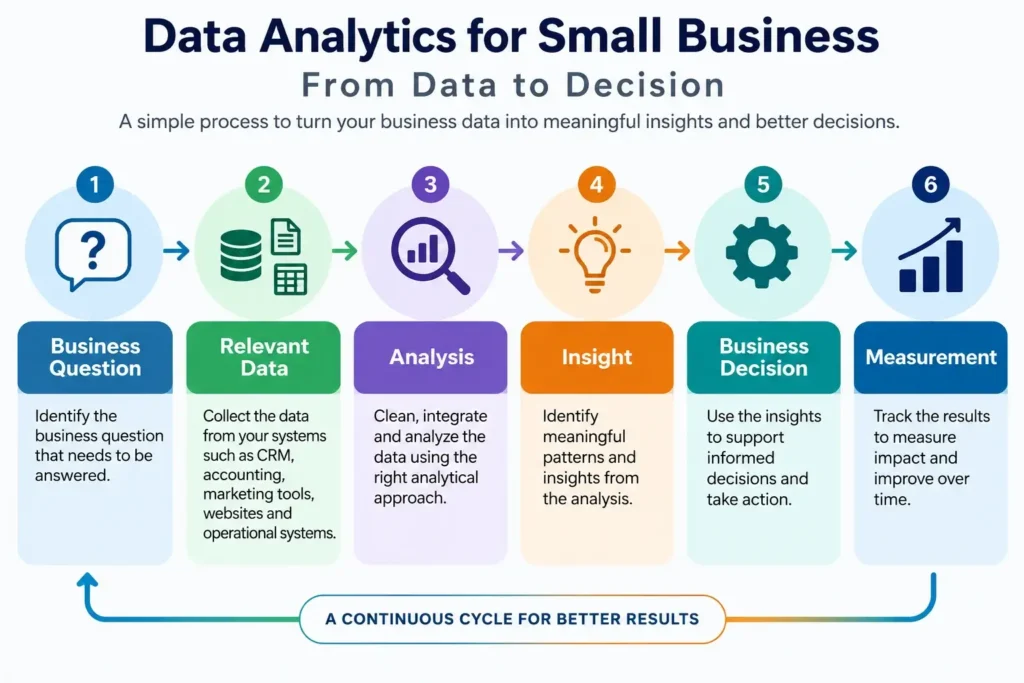
A simple way to look at the process of data analytics is:
Business question → Relevant data → Analysis → Insight → Decision → Measurement
Why Data Analytics Matters for Small Businesses
Data analytics equips small businesses to make better decisions regarding their limited resources.
Most businesses can easily get confused when looking at the top line of their financials (revenue). The company may appear to be growing, but it may not be. A further analysis might reveal that revenue is growing by way of the sale of low-margin products or maybe even by way of excessive use of deep discounts. The sales and business development process may also be very cost-intensive, thereby eroding profit margins.
The result of this analysis would form the basis of very different decisions than simply trying to keep increasing sales.
The same is true of customer analytics as well, knowing how many customers a company has does not reveal how much value each customer represents, which products that customer buys or where that company’s customer retention is down. Analytics can reveal patterns for a business and show where management should focus its efforts for the highest impact.
What Can a Small Business Analyze?
These are the most typical areas any small business could go on to analyze, depending on their individual needs and goals.
- Sales and revenue analytics: Track and analyze revenue trends, product sales and customer contribution to sales.
- Customer analytics: Purchasing behavior, customer segmentation, repeat business and customer retention.
- Marketing analytics: Connects campaign data with activity on your website, with leads generated through your campaign and with conversions made by your customers.
- Financial analytics: Track revenue and expenditure, margins and profitability as well as cash flow.
- Operational analytics: Tracks inventory, order processing, delivery and service issues, such as the time it takes for a business to respond to customer inquiries and service calls.
- Forecasting and predictive analytics: Analysis of historical data to support sales forecasting, demand planning, business planning, etc. The quality of results depends on the amount of reliable data available.
It is important to remember that the information generated from analysis is meant to answer specific questions from management and help improve performance, rather than just to keep producing more reports.
The Real Challenge is having data but limited analytics capability
Many small businesses have already accumulated data but do not have the required time and skills to properly analyze the information.
Sales data, customer data, marketing data and financial data (to name a few examples) are typically stored in different systems, and in some cases even in spreadsheets.
Most reporting today is still done in spreadsheets, and before analysis can even start, data must be cleaned, integrated and even standardized across the various systems.
Having lots of data can itself create huge problems for businesses, as there is just too much information and none of it seems to answer the important questions for them.
That is one reason a business would look to an external analytics partner to help solve its problems.
When Should a Small Business Consider an Analytics Partner?
There is no minimum business size, in terms of revenue or number of employees, for needing an external analytics partner. The threshold is purely determined by the business needs and the analytics capabilities of the in-house team.
An external partner may be useful when:
- Reporting depends heavily on manual spreadsheets.
- Data is spread across disconnected systems.
- Management needs more analysis than the internal team can provide.
- Employees spend too much time preparing reports.
- The business requires specialist skills, for example in data engineering, business intelligence or predictive analytics, that the current staff cannot provide.
- Hiring a complete analytics team would not be practical.
Work with an external provider as much or as little as you like. Start with one project or work to solve one business problem, and then expand the engagement as required.
In-House Analytics vs. an External Analytics Partner
| Factor | In-house team | External partner |
|---|---|---|
| Investment | Recruitment and technology costs | Can start with a defined project |
| Expertise | Depends on internal hiring | Access to specialist capabilities |
| Scalability | May require additional hiring | Capacity can change with requirements |
| Business knowledge | Strong internal knowledge | Partner needs time to understand the business |
| Control | High direct control | Depends on engagement model |
| Best fit | Sustained analytics demand | Specialist expertise or flexible capacity |
An internal team can offer strong business knowledge and close integration with management functions. However, establishing a complete and effective function to deliver analytics requires a number of different capabilities.
An external partner will bring all the required skills to a company, whereas an internal function can be very hard to staff with all the required specialist skills. A hybrid approach is also possible and can be a good compromise between an external partner and an internal function: the company’s own employees act as the business owners and work with the partner, who provides the required analytics skills.
Dashboard Provider vs. Business-Focused Analytics Partner
| Dashboard-focused provider | Business-focused analytics partner |
|---|---|
| Focuses mainly on reporting | Starts with the business problem |
| Shows performance | Helps interpret performance |
| May work with limited data sources | Can integrate multiple sources |
| Primarily explains what happened | Can investigate why it happened |
| Dashboard is the main deliverable | Insights and recommendations can be included |
Monitoring performance by means of dashboards is only part of analytics.
The cause of decreased sales in one region could be lower pricing, a different customer mix, lower product availability at retail stores or even more competition from local businesses or online competitors. The sales activity of your retail stores could also have decreased.
Going from what happened to why it happened, and then from why it happened to what should happen, is even more important in order to grow your business in the best way possible.
How to Choose the Right Data Analytics Partner
First, choose a provider who understands your business problems before promoting solutions.
Business Understanding
They should have a good understanding of the business model of your company and its objectives.
Data and Integration Capability
They should be able to work with the different systems you already have, sort and cleanse your data and address any issues with data quality or consistency.
Analytics Capability
Can they support your future needs? This could be, for example, business intelligence, data analysis, predictive analytics, data science or even analytics engineering.
Scalability
Your analytics partner needs to support your business as it develops and grows. For example, the initial need for reporting and analysis of current data will grow to include forecasting, customer analytics and even an analysis of profitability.
Communication
Findings must be communicated to decision-makers to provide them with value. They need to be explained in simple terms and connected to business applications and issues.
Ongoing Support
What happens after the initial dashboard has been created and the analysis has been delivered? The needs of the business with regard to analytics will evolve as the business grows.
Data Privacy Should Also Be Considered
When sharing customer or other sensitive business information with an analytics provider, consider the business’s information privacy when selecting a business partner.
Consider what will be done with the data provided by the business and how it will be protected in case of a security or privacy incident.
These considerations also relate to NIST’s recommendation that small businesses understand how customer information will be handled by service providers for data analytics.
Be sure to consider these issues prior to engaging a provider rather than after the fact.
Questions to Ask Before Choosing a Partner
Before selecting an analytics provider, ask:
- What business problems can you help us solve?
- Can you work with our existing systems?
- How do you handle incomplete or inconsistent data?
- How will you protect the data we provide?
- Can we start with a smaller project?
- Will you provide recommendations or only reports?
- Who will work on our project?
- Can you work alongside our existing employees?
- How can the engagement scale later?
From the answers to these questions, you will be able to tell a technology provider apart from a business partner.
Why Starting Small Can Be the Right Approach
Small businesses don’t need to analyze all of the possible data that is available to them to begin utilizing analytics.
Start by analyzing the data for one business problem first. Take the example of a company with decreasing revenue. Most people would first come to the conclusion that the company needs more leads. But spending a lot of money on marketing to increase leads might not be the best first step. Start by analyzing sales in more detail: by product, by customer segment, by region, by marketing channel and by sales stage.
The analysis finds that lead volume is not the problem that the company initially assumed. In fact, there are customer segments where the conversion rate has decreased dramatically, as well as specific products where demand has fallen sharply.
The conclusions drawn from such an analysis would lead to a completely different business decision than increasing lead generation spend in order to drive up revenue.
A practical analytics project can therefore follow this flow:
Business problem → Data → Analysis → Insight → Decision → Measurement
How Kepler Advanced Analytics Supports Small Businesses
For businesses that need access to analytics capabilities and cannot immediately build out a full internal team of specialists, Kepler Advanced Analytics supports the full analytics lifecycle: data preparation and integration, business intelligence, analytical work, advanced analytics, predictive analytics, data science and analytics operations support.
Your analytics engagement can start with a simple reporting requirement, a specific analytical project or even a very specialized need.
The analytics services can be delivered from multiple locations, including Detroit, Paris, Shanghai and Chennai, across different markets.
The aim of our service is not to produce simple dashboards, but rather to help companies better understand their data, identify decisive factors and support their business decisions by means of their data.
What Does the Right Analytics Partner Look Like?
The need for a suitable partner will depend on the business objectives of the company. A company that consolidates its sales and financial data will have different requirements than an e-commerce company that requires customer analytics or even forecasting.
However, the fundamentals remain constant. A suitable partner for the analytics needs of a business is one who can understand the business problem of a customer and understand the data already in existence with that customer, and thus apply the appropriate amount of analytical capability to arrive at solutions that can be clearly communicated to the customer and scaled as needed.
An in-house analytics team may be the best solution for some organizations, while others require the expertise of an external partner. The key is to find flexible resources that deliver the appropriate level of expertise for the organization’s needs.
Rather than looking for a supplier to produce a dashboard for you to view, start with the business issue you are looking to address. Once you have clearly defined the business question, identifying the right data, analytical approach and supplier to address the query becomes a lot easier.