
Late deliveries cause problems throughout the entire delivery chain. Customers may lose their trust, call centers may have to handle a large number of calls, and logistics managers may have to solve problems instead of preventing them. Such problems will result in higher expenses, worse service, and strained relations with the customer. The application of predictive analytics in the area of on-time deliveries helps businesses discover the problems ahead of time. By studying historical data on deliveries, transportation processes, inventory, suppliers’ performance, and many other factors, specialists can find out whether there are any problems and what needs to be done about them.
Predictive analytics doesn’t have to be perfect in order to be helpful for a company. Predictive analytics gives logistics specialists necessary information when it is still relevant. This paper discusses the principles underlying predictive models, the types of data needed for such analysis, how to choose partners for predictive analytics projects, and how predictions help in making deliveries.
Why Predictive Analytics for On-Time Delivery Matters
Many activities must be completed to achieve on-time delivery. Products must be in stock, orders must be entered accurately, goods must be picked and packed, and carriers must then move them through the planned logistics process. Any delay in this process may affect the delivery. Most firms evaluate delivery performance only after a particular shipment has been delivered. This is useful for explaining past mistakes, but it gives operations teams no time to act.
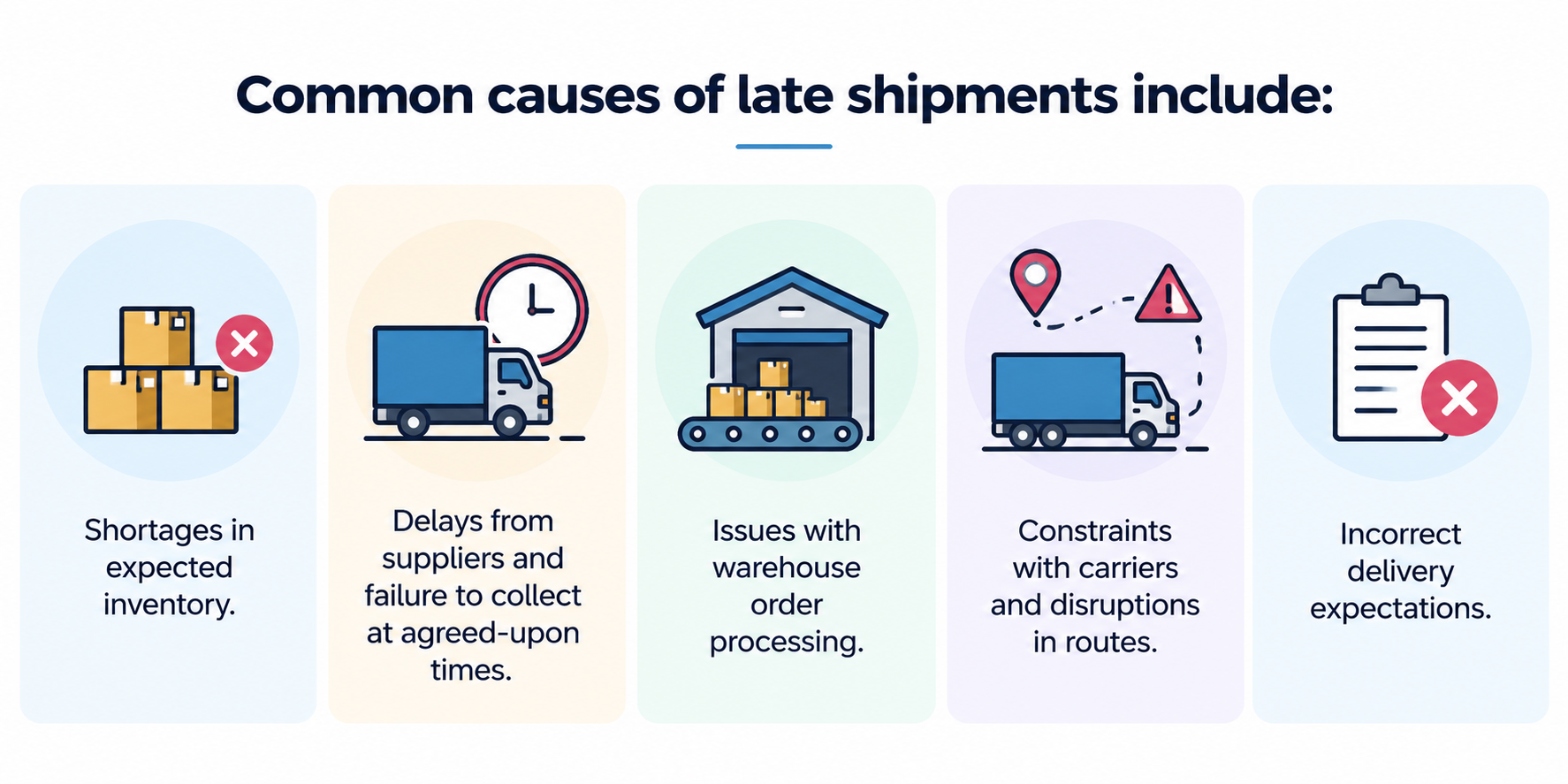
Those tend to happen together. The delay of goods supplied by a vendor becomes the scheduling issue of the warehouse, and the latter leads to a carrier picking issue. Data science tools such as predictive analytics help to understand the causes of missed orders. Companies are capable of analyzing their datasets to find out where problems appear and how they occur.
What Predictive Models Actually Do
The technology of predictive analytics utilizes past and current information on logistics in order to make predictions about future events. Machine learning is a method that allows computers to learn from data patterns in order to predict future events. In delivery processes, a group may apply models to identify risks, to predict arrival times, to predict delays, and to analyze the potential reasons for service failure.
Risk Scoring of Shipments
The risk scoring is a prediction model that calculates the probability of a delay in the delivery of a particular shipment beyond the agreed-upon delivery time. The factors taken into account during this process are supplier delays, availability of inventory, processing times in warehouses, carrier efficiency, and route conditions.
Estimation of Arrival Prediction Model
Estimated time of arrival (ETA) is a prediction model that gives an estimate of when the delivery is to be delivered.
Lead-Time and Dwell-Time Forecasting
Lead time is the time period that occurs between the start point and endpoint, such as from order placement to its receipt. Dwell time is the time period that a shipment spends at a facility, warehouse, terminal, or transfer point. With forecasting of these periods, companies
Logistics Data That Can Be Used To Predict Delivery Delays
The accuracy of a model depends on the quality of the data used to create that model. A company should evaluate its data before creating the model in order to determine if the data will be adequate for determining the order flow and where there are delays.
- Order Data: Order data will include the date of order placement, promise date for delivery, whether it is a rush order, destination, and any other relevant characteristics of the order.
- Inventory data: What inventory is available? Is there a back order? When will the stock be replenished? Has the stock been allocated?
- Warehouse data: What is happening with orders once they leave the warehouse? When were they picked? When were they packed? When were they dispatched? When were they handed off to the carrier?
- Transport data: What data does the transportation company provide? What is the planned route? What are the expected transit times? When does it update the shipment’s location? What constitutes proof of delivery?
- Supplier data: What is the supplier’s lead time? When was the order actually delivered? Was the delivery incomplete? Have there been recurring delays?
- Service data: What are the service commitments to the customer? What are the historical exceptions?
What else can we learn from external data? Is there any external condition, like weather or traffic, that impacts delivery?
The data must be standardized. Are there any inconsistencies in the way dispatches are defined across systems of record? Was there a promise to deliver? What was the shipping ID number? Was it promised to make a delivery?
There is a requirement to develop a common vocabulary for critical events.
How Does ETA Prediction Allow Teams to Act Earlier?
Another use of predictive analysis in logistics is predicting ETAs. Typically, ETAs are calculated based on scheduled transit times or delivery windows. With predictive analysis, ETAs can be predicted based on past performance and indicators of the particular shipment.
For example, a shipment can be on track with respect to its scheduled ETA however, when looking at the transfer history of the shipment, it can be seen that it takes longer than expected for it to move from one facility to the other. In case similar transfers have proven to take more time than expected and miss delivery windows in the past, then the shipment is marked as risky.
Predictive ETAs can be useful in making many different business decisions:
- Pinpointing delivery cases that will be late.
- Assigning priorities to exceptions for the transportation department or the customer service department.
- Improving the planning of delivery processes and the scheduling of intervention efforts.
- Evaluating other means of delivering the products or services.
- Identifying consistent delays associated with certain facilities or carriers.
The usefulness of the predicted arrival times will depend on the frequency of the updating process and the accuracy of the predictions made by the model. The model might recognize the disruptions, yet not predict the exact arrival time. Predicted delays have several differences from the confirmed delays. The high-risk cargo may be delivered on time, but the low-risk cargo may face delays and will be delivered late. The company needs to determine the point of action.
Improving OTIF and On-Time Delivery Rate
- On-time delivery rate is the measurement of how many deliveries come within the scheduled time or date. OTIF means “on time, in full” – that is, the delivery comes on schedule with all of its necessary products.
- Both OTIF and on-time delivery rate are connected but different. On the one hand, the delivery could be timely but the business does not deliver the entire order. The latter may miss any service failures when only one delivery criterion is considered the time when the delivery arrives.
- Predictive insights may also help identify suppliers or carriers that will increase the risk of delivery failure, or routes or facilities that will cause service failures.
- The measurement of delivery commitment indicates that there is an understanding within the group of what “on time” means, how partial deliveries will be treated, and if the measure is based on shipment, order, or item level.
- Measurement consistency is needed before and after the implementation of a predictive analytics solution. The improvement in the service metrics can be the result of a shift in the way the organization measures delivery commitments rather than actual service improvement.
How Teams Use Predictions During the Working Day
A daily list of exceptions ensures concentration on exceptions and problematic shipments/orders. Rather than examining each shipment/order one-by-one, the team can apply predictive analytics for identifying the following exceptions:
- At-Risk Shipments: Shipments that have a high probability of failing to meet the agreed-upon delivery date/time.
- Supplier Exceptions: Exceptions related to shipments that may be risky because of no supply.
- Warehouse Exceptions: Shipments that get delayed due to picking/packing/process/delivery.
- Carrier Exceptions: Deliveries that fail because of carrier issues, route problems, or missed collection.
- Incomplete Orders: Exceptions caused by incomplete orders because of lack of products/quantities and order processing.
Each exception has to be accompanied by the shipment/order number, cause for concern (if known), risk rating, and actions needed. The responsible parties (suppliers, carriers, stocking point, etc.) can be identified. Exception lists must be reviewed throughout the workday in order to deal with the risk in time, before delivery exceptions occur.
Common Errors That Undermine Predictive Analytics Outcomes
Beginning with the model rather than identifying a business problem. For example, the statement “I want to apply AI in my logistics operation” is too broad and cannot help develop an effective solution. Instead, one can think about using a statement such as “I want to find out why deliveries always fail on a certain route”.
- Using bad historical data: Bad data means incomplete and irrelevant data, but such data is used to create a model. Poor data needs to be fixed before the model is created.
- Not setting alert thresholds: Systems may be created in such a way that they notify their users about some possible problem, but too many alerts will not let users act on that information.
In addition, if the alert is related to customer orders, the threshold for sending the alert needs to be set at an even lower level.
- The lack of measuring the right aspects: It is great to increase model efficiency, but what about the business process itself? Is everything being delivered on time? How satisfied are customers?
- Improvements are not localized: One way to make progress is by designing and implementing an improvement program locally to build up knowledge regarding improvement process implementation.
The Choice of a Predictive Analytics Partner
Firms Offering Predictive Model Services:
There are several types of predictive analytics vendors that companies can choose from, depending on their needs and capabilities.
- Big consultancy firms: These firms can handle more complex projects and large-scale transformations. However, their services are likely to be more expensive, and smaller projects may not receive sufficient attention.
- Specialised data science firms: These firms specialise in statistics, machine learning and predictive modelling. They can be a good choice for companies that need such solutions, but their supply chain experience may be very limited.
- Supply chain analytics specialists: These vendors specialize in analytics of the supply chain analytics. They can be a good choice when you need to address problems related to late deliveries, supplier performance, inventory management, and delivery forecasting. It is worth checking the scope of their services and capabilities.
- Analytics consultancies: Smaller consultancies can be a good option when a company wants more direct contact with experts. However, before choosing such a vendor, it is important to evaluate its ability to implement the project, monitor it, and further develop it.
When choosing a vendor, one should evaluate its project experience, data requirements, and model validation techniques.
Timeline of a Realistic Implementation Plan
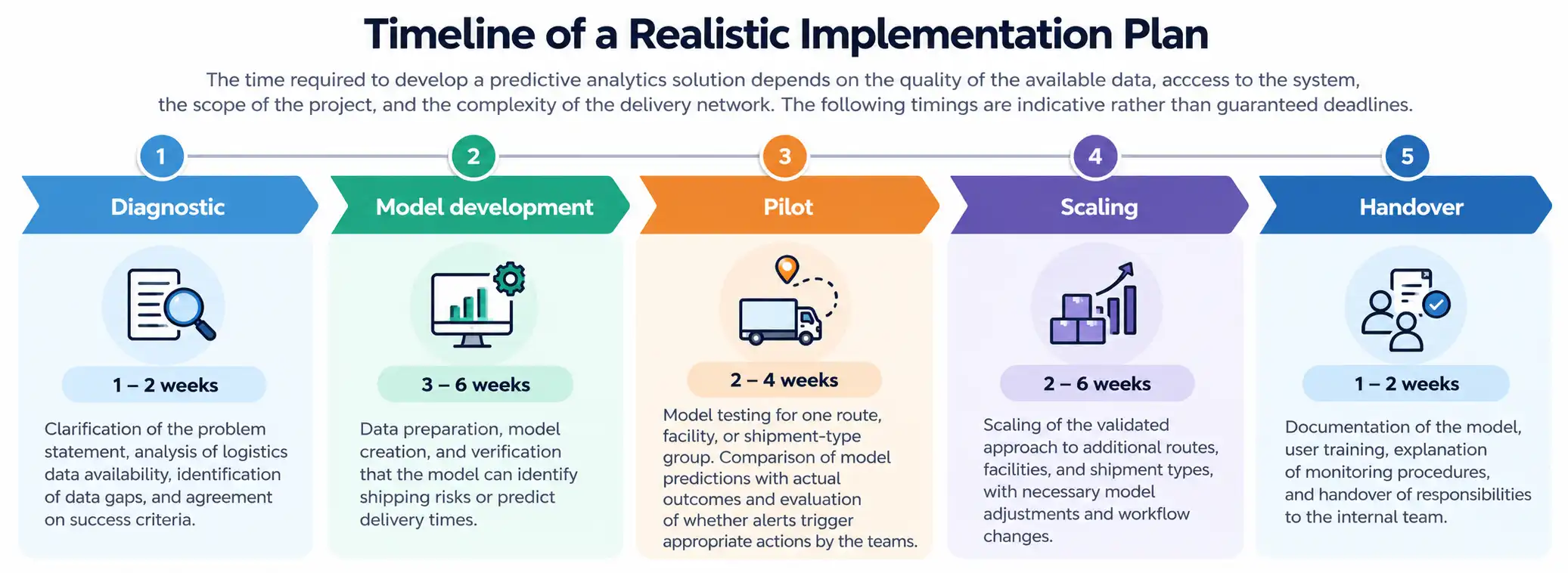
Phases may overlap, and data quality issues or complex system integration will extend the timeline.
Ways Kepler Advanced Analytics Can Assist
Kepler Advanced Analytics helps businesses use their logistics data to understand delivery risks and make decisions based on:
- Delivery performance diagnostics to pinpoint the causes of delays.
- Predictive analytics for shipment risk, ETA, and lead time.
- Network and inventory optimisation.
- Power BI visualisation and a control tower for shipment tracking.
- Monitoring of predictive models.
To discuss a suitable approach for the business, contact the KAA team.