
The supply chain issues that are being seen within the auto industry were brought into focus as a result of various elements including but limited to; risk of semiconductor supplies, U.S. trade tariff’s imposed by countries including China, restrictions placed upon exporting critical mineral resources, and OEM’s large investments in Electric Vehicle technologies. As a direct result of these events, the overall stability of the supply chain has been disrupted and it is becoming increasingly difficult for Original Equipment Manufacturers (OEM) and First Tier Suppliers to predict when or if they will receive products from their upstream suppliers.
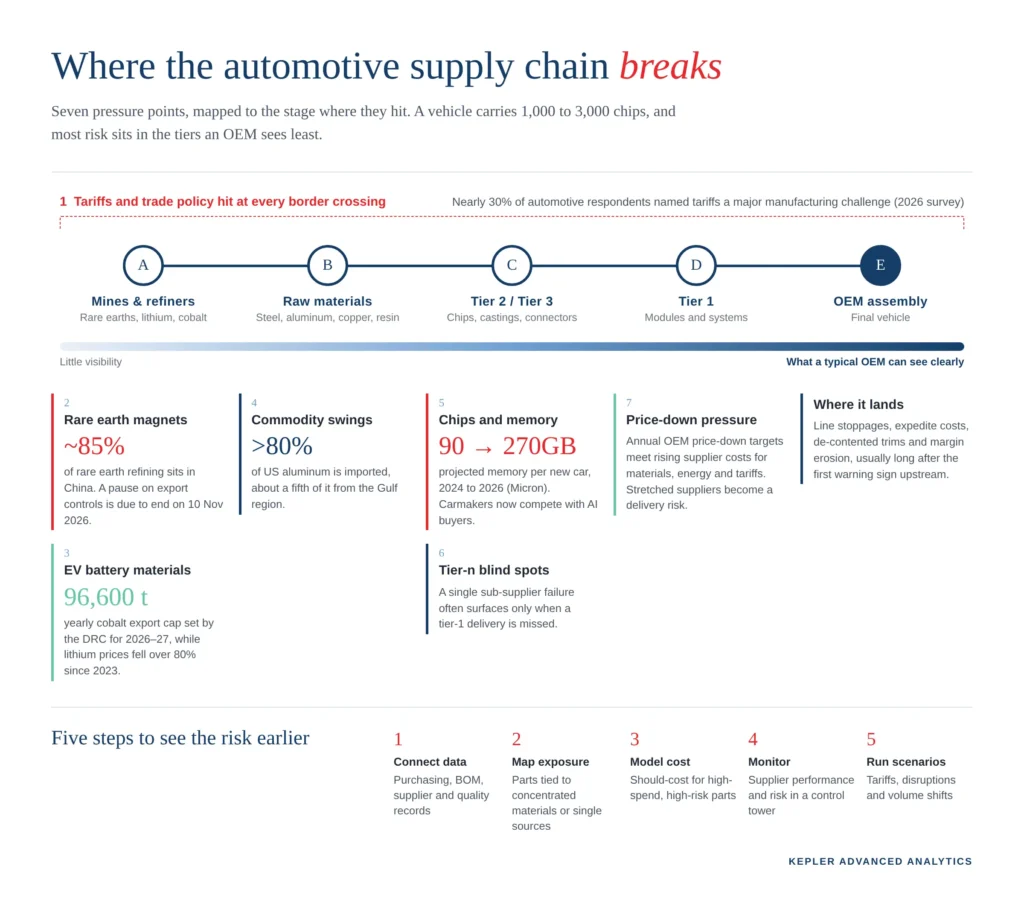
The automotive supply chain challenges at a glance
The table below summarizes the seven challenges covered in this article.
| Challenge | What’s driving it | Typical impact |
|---|---|---|
| Tariff and trade policy volatility | Shifting tariffs on automobiles, parts, steel, aluminum and associated trade disputes | Higher landed cost, rapid re-sourcing, profit margin pressure |
| Semiconductor and memory chip shortages | Increased chip content per automobile; competition for chip supply from AI and data centers; geopolitical tensions | Production reductions, reduction of component content (“de-contenting”) and increased expediting costs |
| Critical minerals and rare earth magnet disruptions | Refining is heavily concentrated in a few countries; export restrictions on critical minerals such as heavy rare earths and graphite anode materials | Supply risk to EV motors, sensors and actuators; price surges |
| Transition to electric vehicles and battery supplies | Unpredictable demand for electric vehicles; regulations governing battery material sourcing | Overbuilding capacity; unclear volume expectations for suppliers |
| Raw material and commodity price fluctuations | Aluminum, steel, copper and resin price fluctuations; local supply disruptions | Excessive costs; contractual disputes; supplier repricings |
| Limited visibility beyond tier 1 | Deep multi-tiered supplier networks with limited shared information | Late identification of disruptions; potential single point-of-failure risks |
| Cost pressure and annual price-downs | Annual OEM-imposed price decreases on suppliers; increasing costs for raw materials, energy, labor and tariffs for suppliers | Risk of reduced quality and delivery capability from financially strained suppliers |
1. Tariff and trade policy volatility
Tariffs create one of the most difficult items to predict in the industry today. Tariffs on completed vehicles, components, steel, and aluminum have fluctuated multiple times over the last few years, and rules of origin decide whether a component qualifies for reduced duty treatment.
The industry feels it. In a 2026 survey conducted by Automotive Manufacturing Solutions and ABB, approximately 30% of automotive respondents reported that tariffs were a major manufacturing concern.
The practical problem is speed. Once a tariff is altered, procurement needs to identify which parts are impacted, how much the landed cost will increase, and which alternatives exist among the remaining suppliers or originating countries. Companies possessing data at part-number level can model the effects quickly. Companies reliant upon summaries of spending cannot.
Nearshore and onshore options may help reduce exposure but will also increase costs and lead times. This is an issue that can be addressed through scenario planning, not instinct.
2. Semiconductor and memory chip supply
There was a significant shortage of microchips after the COVID-19 pandemic. However, this did not eliminate the risk. Rather, it simply altered the form.
Microchip content per vehicle continues to rise with driver assistance systems, infotainment systems, electrification etc. Memory is a clear example of this trend. According to Micron, the average new car will have combined RAM and NAND content increase from 90GB in 2024 to more than 270GB by 2026. As such, original equipment manufacturers are now competitors with artificial intelligence and data center buyers for that memory.
Additionally, geopolitics adds another layer to the issue. The dispute around Nexperia, a major supplier of basic automotive semiconductors, demonstrates how quickly a corporate and government dispute can threaten the availability of low-cost essential parts across multiple programs.
Supply chain teams are faced with reduced visibility to semiconductors due to the fact that microchips often arrive at OEMs buried within modules supplied by first-tier and second-tier suppliers. Therefore, while the OEM knows which first-tier supplier provides each module, the OEM does not know which company manufactured the microchip inside that module or where the microchip was made.
3. Critical minerals and rare earth magnets
Permanent rare-earth magnets are used in electric motors, power steering systems, sensors and many small actuators. Supply is highly concentrated. China accounts for roughly 85 percent of world refining of rare earths, and export controls have already shown how quickly concentration can turn into shortage.
Timing matters here. One package of Chinese export restrictions covering heavy rare earths, related magnets and graphite anode materials has been suspended. However, that suspension expires on November 10th, 2026. Suppliers without validated alternative sources face real risks if restrictions return.
Other battery and electronics materials carry similar concentration. The Democratic Republic of Congo provides approximately 70 percent of mined cobalt and has capped exports at 96,600 tonnes annually for 2026–27, roughly half of 2024 export volumes.
The table below shows how concentrated some key inputs are.
| Input | Where it’s used | Supply concentration |
|---|---|---|
| Rare earth elements | Motor magnets, sensors, actuators | China refined about 85% |
| Natural graphite | Battery anodes | China produced roughly 82% |
| Cobalt | Battery cathodes | DRC supplies roughly 70% of mine output |
| Six refined critical minerals | Batteries, electronics | Top three refining countries accounted for 86% share in 2024, up from about 82% in 2020 |
4. The EV transition and battery supply chains
The shift to electric vehicles has changed the bill of materials. In EVs, gas engines, transmissions and fuel systems give way to battery packs, power electronics and electric drive units, each with its own supply chain.
The difficulty is that EV demand hasn’t followed a straight line. There has been strong adoption in certain markets but slower adoption in other areas, and changes in policy incentives have impacted suppliers that invested in capacity specific to EV technology. Meanwhile, OEMs must run combustion, hybrid and electric programs simultaneously.
Battery materials add additional volatility. Lithium prices have decreased by more than 80 percent since 2023. Meanwhile, cobalt prices rose significantly in 2025. Regulations that tie incentives to where minerals are mined or processed make supplier selection more complex.
5. Commodity and raw material price swings
Raw materials (steel, aluminum and plastic resins) account for a large percentage of direct material cost and therefore represent a great deal of volatility based on changes in energy prices, trade policies and regional disruptions.
Aluminum shows how rapidly this can happen. The US imports over 80 percent of the aluminum used in US products. Additionally, about 20 percent of those imports come from the Gulf region; therefore, conflict affecting shipping routes involving Gulf nations could potentially cause concerns for automaker supply chains.
Index-based pricing contracts for raw materials are commonplace throughout the industry. However, absent clearly defined linkages between each component (parts), their associated material content and relevant indexes, it becomes difficult to determine whether a supplier’s price increase is justified. This gap represents where cost modeling can provide value.
6. Limited visibility beyond tier 1
While most OEMs understand their tier-1 suppliers relatively well, fewer can see clearly into tier-2 and tier-3 suppliers, where many disruptions originate.
A tier-1 module supplier may depend on only one tier-2 source for castings, connectors or chips. Should that single source fail, the OEM typically doesn’t learn about it until the tier-1 supplier misses a delivery. At that point, options are expensive and limited.
Creating multi-tier visibility requires several types of data, including bills of materials, supplier surveys, shipment data and external risk signals, plus a way to integrate them so a disruption at a sub-supplier can be tracked back to affected parts, vehicles and programs.
7. Cost pressure and price-down requirements
Automotive procurement has historically utilized annual price-down targets provided by OEMs to suppliers. That model is increasingly challenged today given rising costs for suppliers due to raw materials, energy, labor and tariffs.
If price-down targets are pushed too hard, then there exists significant risk to both suppliers and OEMs. Financial distress experienced by suppliers may result in quality and delivery capability reductions, tooling investment funding failure or even bankruptcy, which would convert a cost savings opportunity into a supply disruption risk.
Therefore, a more sustainable approach is fact-based negotiation. Part-level should-cost models represent the expected cost for components based upon material, process and overhead expense. Procurement can use these models to separate legitimate increases from padding, and find savings which don’t require margins to be squeezed to the limit.
How analytics helps manage automotive supply chain challenges
Although none of these challenges can be eliminated, they can all be better managed using the right information and data. Below is an overview mapping each challenge to the appropriate analytics solution.
| Challenge | Analytics approach | What it delivers |
|---|---|---|
| Tariff volatility | Landed cost modeling at part level and tariff scenario modeling | Quick assessment of impact and alternatives |
| Chip and component shortages | Bill of materials mapping at multi-tier levels and supply risk scoring | Early warning system for exposed parts and programs |
| Critical minerals and rare earth magnets | Material content mapping and supplier risk analytics | Complete picture of exposure by part, supplier and country |
| EV volume uncertainty | Demand scenario modeling and capacity planning at EV supplier level | Better sizing of supplier capacity commitments |
| Commodity price fluctuation | Direct-material cost modeling linked to commodity indices | Objective basis for pricing discussions |
| Limited tier-n visibility | Control tower providing view of supplier performance, open orders and risk alerts | Unified view of supplier performance and risk |
| Price-down pressure | Purchasing and spend synergies at group level (multiple plants, branches or acquisitions) | Savings from consolidation and pricing gaps, not simply margin compression |
Examples from automotive engagements
Beginning with the ground work of connecting purchasing, supplier and part data in a structured manner, enabling procurement teams to utilize the information, each of the above examples (i.e. procurement control tower; purchasing synergy analysis; direct material cost modeling) have demonstrated value in the application of advanced analytics in automotive procurement.
To build resiliency in an automotive supply chain does not come from the deployment of a single tool or from making a single source selection. Resiliency is achieved by understanding how a part is purchased (from which supplier), made (what materials), sourced (from which country) and testing how the various elements of the process react if any one element were to change.
In many cases a practical approach would be:
- Clean and Connect Data – Combine purchasing, Bill of Materials, Supplier Master and Quality Data into One Structure
2. Map Exposure – Determine Parts and Programs Exposed to Concentrated Material Sources, Single Suppliers and Tariff Sensitive Countries
3. Establish Cost Transparency – Develop Should-Cost Models for High Spend/High Risk Parts
4. Continuously Monitor – Place Supplier Performance, Open Orders and Risk Signals into Control Tower
5. Create Scenarios – Test How Tariff Changes, Supply Interruptions and Volume Shifts Affect Your Business Prior to Occurrence
How Kepler Advanced Analytics Can Help
Kepler Advanced Analytics provides data and analytics solutions to assist vehicle Original Equipment Manufacturers (OEMs) and Tier 1 Component Suppliers to effectively manage their respective supply chains in the automotive industry. Our team consists of experienced automotive procurement professionals and analytics engineers who combine experience and technical capabilities to provide solutions using an off-shore delivery model.
Typical support includes:
- Direct-Material-Spend-Diagnostic: A fixed-fee analysis (audit) of your company’s direct-material-spend, providing insight into costs, price variances and supplier concentrations.
- Should-Cost & Direct-Material Cost Modeling by Part Number Level using Company Data in SAP or other ERPs
- Control Towers for Procurement that aggregate data from Suppliers’ Performance; Open Orders and Risk Alerts
- Mapping of Supplier Risks and Exposure related to Critical Minerals, Semiconductors and Tariff Sensitive Parts
- Analyzing Purchasing Synergy & Spend Analysis among groups having Multiple Plants; Business Units; Recent Acquisitions
- Modeling Tariffs and Scenarios to Support Near-Shore and Dual Sourcing Decisions
To discuss how analytics can strengthen your automotive supply chain, contact Kepler Advanced Analytics.