
On a Monday morning, a materials planner at an assembly plant might open three spreadsheets, two supplier portals and an inbox full of schedule changes before working out which parts could run short this week. Most of that time goes on gathering and checking data rather than deciding anything. That gap, between the information that exists somewhere and the decisions people need to make with it, is where AI in automotive supply chain management tends to earn its place.
The phrase covers a lot of ground, and some of it is oversold. Machine learning can forecast demand and flag late shipments well when it has decent history to learn from. Optimization models can work out stock levels or delivery routes faster than any spreadsheet. Generative AI can read contracts, invoices and supplier emails and pull out what matters. None of these replace planners or buyers, though, and all of them depend on data that many automotive companies still struggle to bring together.
This article looks at the areas where AI is proving useful in automotive supply chains, the kinds of models involved, the data foundation they rely on, the mistakes that stall projects, and a sensible way to begin.
What “AI” actually means in a supply chain context
In practice, most of what gets called AI in supply chains falls into a few families. Machine learning models learn patterns from history, which makes them useful for forecasting demand, predicting delivery delays or spotting suppliers whose performance is drifting. Anomaly detection, a branch of the same idea, picks out data points that don’t fit the usual pattern, such as an invoice that’s far above the contracted rate or a sudden jump in scrap at one plant.
Optimization is a slightly different animal. Strictly speaking it’s mathematics rather than AI, but it often sits alongside machine learning, taking a forecast and working out the best inventory levels, production sequence or delivery route within real constraints like capacity, lead times and minimum order quantities.
Generative AI and large language models are the newest addition. They’re good at reading and summarizing unstructured text (contracts, quality reports, supplier emails, engineering change notices) and at letting people ask questions of their data in plain language. More recently, “agents” built on these models can carry out multi-step tasks, like checking stock, drafting a supplier message and logging the action, usually with a person approving the important steps.
Where AI is proving useful
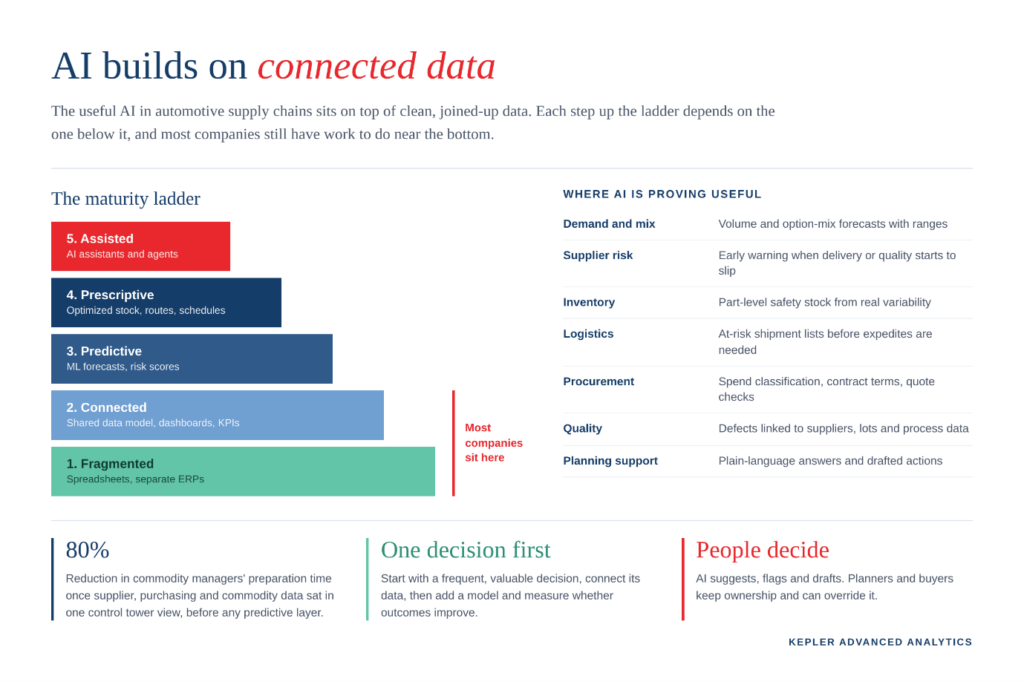
The table below gives a quick view of the main areas and what AI typically produces in each.
| Area | What AI does | Typical output |
|---|---|---|
| Demand and mix forecasting | Learns demand patterns and drivers | Volume and option-mix forecasts with ranges |
| Supplier risk | Spots deteriorating supplier performance | Risk scores and early warnings |
| Inventory and replenishment | Sets stock levels from demand and lead-time variability | Part-level safety stock and reorder points |
| Logistics | Predicts late shipments and arrival times | At-risk shipment lists, better ETAs |
| Procurement | Classifies spend, reads contracts, supports cost models | Clean spend cubes, extracted terms, price gaps |
| Quality | Links defects to suppliers, lots and process data | Early warning of quality escapes |
| Planning support | Answers questions and drafts actions in plain language | Faster exception handling |
Demand and mix forecasting
Forecasting is usually the first place AI shows a measurable gain. Machine learning models can combine order history with drivers such as incentives, fuel prices, model launches and dealer stock, and they handle option and trim mix better than most spreadsheet methods. The more useful models also give a range rather than a single number, which matters for electric vehicle programs where demand has been hard to call. The approach builds on the methods described in automotive demand forecasting using data analytics.
Supplier risk and early warning
Supplier problems rarely appear without warning; delivery performance usually slips, quality escapes creep up or payment requests change weeks before a real failure. Machine learning can watch those signals across hundreds of suppliers at once and raise a flag when a pattern starts to look like trouble, which is the core of supplier risk analytics in the automotive industry. Generative AI adds a further layer by reading news and financial filings about suppliers and summarizing anything relevant.
Inventory and replenishment
Here AI mostly feeds better inputs into proven methods. Forecasts with realistic error ranges, and lead-time predictions that reflect how suppliers actually perform, let safety stock be set part by part instead of with flat day-based rules. The result tends to be less stock overall with fewer shortages, which is the goal of automotive inventory optimization.
Logistics and delivery
Predicting which inbound or outbound shipments are likely to arrive late gives planners time to act before an expedite becomes necessary. Models look at carrier history, lanes, order size and current backlogs, and the at-risk list goes to the people who can do something about it. The same thinking sits behind predictive analytics for on-time delivery.
Procurement
Procurement has a lot of messy text and data that AI handles well. Machine learning can classify millions of purchase lines into a consistent category structure, which used to take weeks of manual work. Generative AI can extract terms, index clauses and price-down commitments from contracts, and help buyers compare supplier quotes against should-cost models. The decisions stay with the buyer, but the preparation time drops a long way.
Planning support with generative AI
Planners and buyers spend a surprising share of their week answering questions like “which parts for this program are below two days of cover?” or “what changed in this supplier’s schedule since Friday?” Language-model assistants connected to the underlying data can answer those in seconds and draft the follow-up message, with the person checking and sending it.
The data foundation decides everything
Most AI projects in automotive supply chains don’t stall on the model. They stall on the data. Purchase orders, receipts, schedules, bills of materials, supplier records and freight invoices often sit in several ERPs and plant systems, with different part numbers and supplier codes for the same thing. A model trained on that mess learns the mess.
So the first stretch of any serious AI program usually looks a lot like ordinary analytics work: matching suppliers across systems, cleaning part masters, joining orders to receipts and shipments, and agreeing on definitions such as what counts as on time. That groundwork is also where much of the early value comes from. When Kepler Advanced Analytics built a procurement control tower for one of the leading players in the North American commercial truck market, bringing supplier, purchasing and commodity data into a single view cut commodity managers’ preparation time by 80%, before any predictive layer was added on top.
The broader point is covered in the role of data analytics in supply chain management: connected, trusted data comes first, and AI builds on it.
Choosing the right kind of model
Different problems call for different tools, and some of the most effective “AI” projects use fairly simple models well.
| Approach | Best suited for | Data needed | Watch-outs |
|---|---|---|---|
| Machine learning (supervised) | Predicting delays, failures, risk | Labeled history of past outcomes | Needs enough past examples |
| Time series and ML forecasting | Demand, mix, lead times | Several years of clean history plus drivers | Struggles with new programs |
| Anomaly detection | Billing errors, quality drifts, odd orders | Large volumes of routine data | Too many false alarms if poorly tuned |
| Optimization | Stock levels, routes, schedules | Forecasts, costs, constraints | Only as good as the inputs |
| Language models (generative AI) | Contracts, reports, emails, Q&A | Documents and connected data | Must be checked; can be confidently wrong |
| AI agents | Multi-step routine tasks | Access to systems and clear rules | Needs approval steps and audit trails |
Keeping people in the loop
Automotive supply chains carry real consequences when decisions go wrong, from line stoppages to customer penalties, so most AI in this space works best as decision support rather than full automation. A model that suggests a safety stock change, flags a supplier or drafts an expedite request is easy to trust once people can see why it made the suggestion and can override it when they know something the model doesn’t.
That also means being clear about accountability. Someone still owns each decision, and the AI’s role is to make that person faster and better informed. Language models in particular need guardrails, because they can produce fluent answers that are wrong, so outputs that feed contracts, supplier communication or financial figures should always be checked.
How far along most companies are
It helps to be honest about the starting point. The table below sketches a typical maturity path.
| Stage | What’s in place | Typical next step |
|---|---|---|
| 1. Fragmented | Spreadsheets, separate ERPs, manual reports | Connect and clean core data |
| 2. Connected | Shared data model, dashboards, KPIs | Add statistical forecasting and alerts |
| 3. Predictive | ML forecasts, risk scores, late-shipment prediction | Link predictions to planning decisions |
| 4. Prescriptive | Optimization of stock, routes, schedules | Automate routine decisions with approvals |
| 5. Assisted | AI assistants and agents supporting planners | Expand scope, keep governance tight |
Plenty of automotive companies sit at stage one or two for most of their supply chain, often with a pocket of stage three in forecasting. That’s fine. Skipping straight to agents on top of fragmented data usually produces impressive demos and very little lasting change.
Common pitfalls
A frequent mistake is starting with a tool rather than a decision. Projects framed as “use AI in the supply chain” drift, while projects framed as “cut premium freight on these lanes” or “warn two weeks earlier when a supplier is slipping” have a clear target and a clear owner. Another is underestimating data work. Teams often plan a few weeks for cleaning and spend months, and a model built on unmatched suppliers or inconsistent part numbers produces results nobody trusts.
Adoption is the other common failure. A forecast that planners override every week, or a risk score nobody understands, quietly stops being used. Involving the people who’ll act on the output from the start, showing how each prediction was reached, and measuring whether decisions actually changed all make a bigger difference than squeezing out another point of model accuracy.
Getting started with AI in automotive supply chain management
A practical first move is to pick one decision that matters and is made often, such as weekly replenishment for a group of parts, supplier escalations or expedite approvals, and look at what data feeds it today. Cleaning and connecting that data, then building a solid baseline with ordinary analytics, usually takes a few weeks and often delivers early savings on its own.
From there a predictive model can be added for that decision, tested against the current approach, and put in front of the people who use it, with a simple way to track whether it’s improving outcomes. Once one use case is working and trusted, the same data foundation makes the next one much faster, and generative AI assistants can be layered on top to help people find and act on the information more quickly.
How Kepler Advanced Analytics can help
Kepler Advanced Analytics helps vehicle OEMs, tier-1 suppliers and automotive distributors put AI in automotive supply chain management to practical use, starting from the ERP, planning, procurement and logistics data they already hold. The work is part of Kepler’s wider automotive data analytics services and supply chain analytics practice, delivered through an offshore model.
Engagements usually begin with a short assessment that picks the decisions with the most value at stake and checks whether the data behind them is ready. From there the team can build the data foundation, then machine learning forecasting, supplier risk scoring, late-shipment prediction, inventory optimization and spend classification, along with generative AI tools for contract and document analysis, all delivered through dashboards in Power BI or the client’s preferred BI tool so the outputs fit into how planners and buyers already work.
Recent Posts
- AI in Automotive Supply Chain Management: Where It Helps, What It Needs and How to Start
- Automotive Logistics Analytics and Transportation Cost Optimization: Finding Where the Freight Money Goes
- Tier-2 and Tier-3 Supplier Visibility in Automotive Supply Chains: Seeing Risk Before It Reaches the Line
- Procurement Analytics for Automotive Manufacturers: Converting Spend Data into Cost Reductions, Lower Supplier Risk and More Effective Negotiations
- Automotive Inventory Optimization: Techniques and KPIs for Finding the Right Amount of Stock in the Right Places at the Right Time